Adult Education Center Nuremberg: Discover Workshops & Courses
Adult Education Center, Workshops & Courses in Nuremberg: How to Plan Your Next Learning Steps
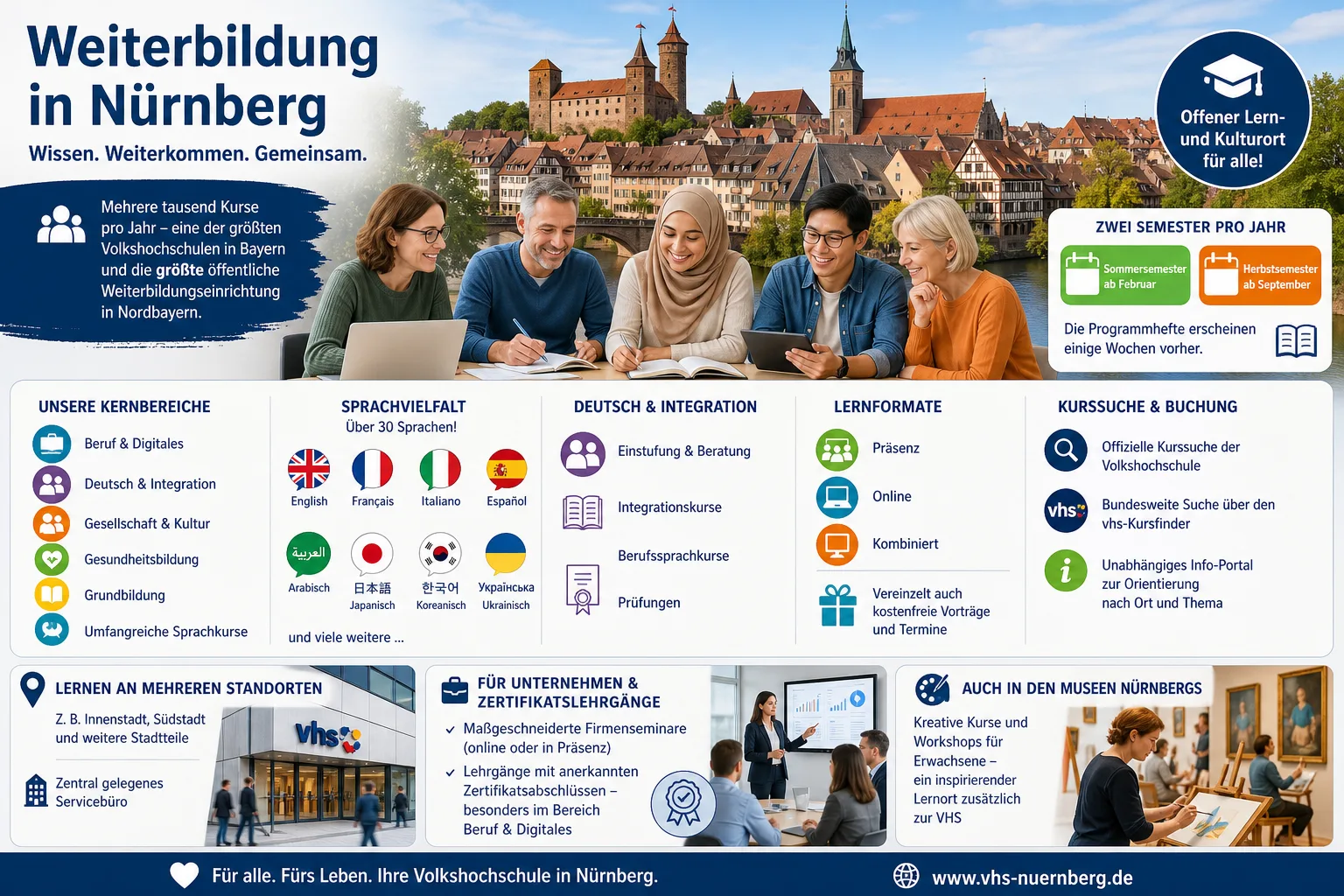
You want to learn something new in Nuremberg in the coming months – a language, a digital tool, a creative craft, or skills for your job? This guide helps you make the most of upcoming course starts, registration steps, and suitable formats so that you realistically stay on track.
Why It Pays Off to Plan Ahead for Upcoming Dates
Many courses are tied to fixed start dates and can fill up quickly – especially if they run in the evenings, on weekends, or as compact intensive formats. If you want to start in the next course phase in Nuremberg, early planning helps you:
- find a suitable date (instead of “any” date),
- choose your learning pace realistically,
- clarify prerequisites (e.g., placement for languages) in time,
- check funding or reimbursement options early if needed.
Important: Always rely on the official course search of the respective provider for concrete start dates, locations, and available spots, as plans can change up to the course start.
Which Course Areas You Will Typically Find in the Future
If you want to orient yourself for the upcoming program phases in Nuremberg, a rough division by learning goals will help. In the next course round, you will often see offerings in these fields:
Career & Digital: Preparing for Upcoming Tasks
If you want to prepare for new projects, a job change, or more confidence in your daily work, courses around digital applications, organization, and communication are often a good next step. When choosing, pay particular attention to:
- the target level (beginner vs. advanced),
- the transferability (“What can I actually do after the course?”),
- the format mix (in-person, online, or hybrid),
- options with certificates – if you need proof for applications.
German & Integration: Next Steps for Everyday Life and Work
If you want to improve your German for everyday life, training, or work in the coming months, a placement and course counseling is often the most sensible starting point. Also plan time for:
- language assessment (if offered),
- regular participation (language acquisition especially benefits from routine),
- exam preparation if you are aiming for a qualification.
For courses with government requirements (e.g., certain integration or job-related language courses), rules on eligibility and procedures apply depending on the program. Check these in the official information before registering.
Society & Culture: Upcoming Lectures, Excursions, and Creative Workshops
If you want to stay curious in the near future without committing long-term, individual lectures, workshops, or shorter series are often the quickest entry point. For this, plan:
- a topic that truly interests you (motivation beats “should know”),
- a fixed slot in your calendar,
- a follow-up option (follow-up course, practice group, or another workshop).
Health & Basic Education: Building Routine for the Next Season
If you want to work on movement, relaxation, or basics in the coming weeks and months, short, regularly scheduled formats are often particularly effective. When choosing a course, make sure that scope and intensity fit your daily life.
Language Courses: How to Prepare for the Next Start
Language courses are a classic because they allow for clear goals and measurable progress. To make sure your next course start goes well, proceed as follows:
- Define your goal: Do you want to speak, write, understand – or prepare for an exam?
- Clarify your level: Use a placement, a test, or counseling so you are neither under- nor over-challenged.
- Choose a format: Evening course, intensive course, weekend workshop, or online live format – choose so that you can reliably participate.
- Plan a practice routine: Set fixed practice times before the course starts (e.g., 3×20 minutes per week).
If you are interested in a less common language, it is worth searching for upcoming dates early and using notification or waiting list functions if offered.
Formats & Times: How to Choose the Right Option for the Next Course Round
In-person, Online, or Hybrid: Decision for the Upcoming Course Phase
- In-person is a good fit if you need fixed dates and benefit from on-site interaction.
- Online live is a good fit if you want to save travel time and can participate reliably with technology.
- Hybrid is a good fit if you want to stay flexible but still need structure.
Semester Logic: What You Should Consider for Future Starts
Many adult education programs are divided into two larger program phases per year (often around spring/summer and fall/winter). For you, this means:
- You can expect recurring “windows” for new course starts.
- The closer the start gets, the more important a quick registration process becomes.
- If you need a specific time frame (e.g., due to shift work), filter early by weekdays and times.
For each upcoming start date: Only the information in the current program or official course search is binding.
Course Search & Registration: Steps for Your Next Booking
If you want to book for the next course round in Nuremberg, selection usually works most reliably through a clear sequence of steps:
- Set a topic: What do you specifically want to be able to do in the coming months?
- Set the framework: Maximum time per week, preferred days, in-person vs. online.
- Filter & compare: Pay attention to prerequisites, dates, duration, costs, location, and cancellation conditions.
- Use counseling: For languages, exams, or funding questions, a quick inquiry before registration is worthwhile.
- Complete registration: Your spot in the next session is usually only secured with confirmation and, if applicable, payment.
Other Workshop Options in Nuremberg for the Coming Months
In addition to classic adult education center formats, you can also look for workshops at cultural and educational institutions for the coming period – for example, at museums or educational initiatives that regularly announce courses, workshops, or lectures. If you want to work creatively, pay particular attention to:
- material notes and prior knowledge,
- duration (one session vs. series),
- target group (beginners, advanced),
- whether results can be taken home (e.g., portfolio, photo project, text).
For planning here as well: Only the information in the current event announcements of the respective providers is binding.
Decision Checklist for Your Next Course
Before you register for the next course in Nuremberg, check these points. If you can tick off most of them, your chances of sticking with it until the end increase:
- Clear goal: I can say in one sentence what I will be better at after the course.
- Realistic timing: The dates fit my daily life – even in stressful weeks.
- Appropriate level: I’m not starting “too high” just to make a quick impression, but at the right level for me.
- Route/tech clarified: Location, travel, or online setup are reliably manageable for me.
- Commitment: I have blocked learning times and informed my environment.