Cultural Education and Societal Discourse in Nuremberg
Cultural Education & Societal Discourse in Nuremberg: What Will Be Possible in the Coming Years
How will Nuremberg change if cultural education is consistently expanded—as a reliable part of education, neighborhood work, culture, and democratic participation? This outlook bundles the most important fields of action that are likely to be decisive in the coming years: access, networking, funding, digital formats, and spaces for discourse.
Goal: Guidance for all who want to plan, support, or use cultural education in Nuremberg and the metropolitan region in the future—from schools, culture, youth services, civil society, administration, science, and business.
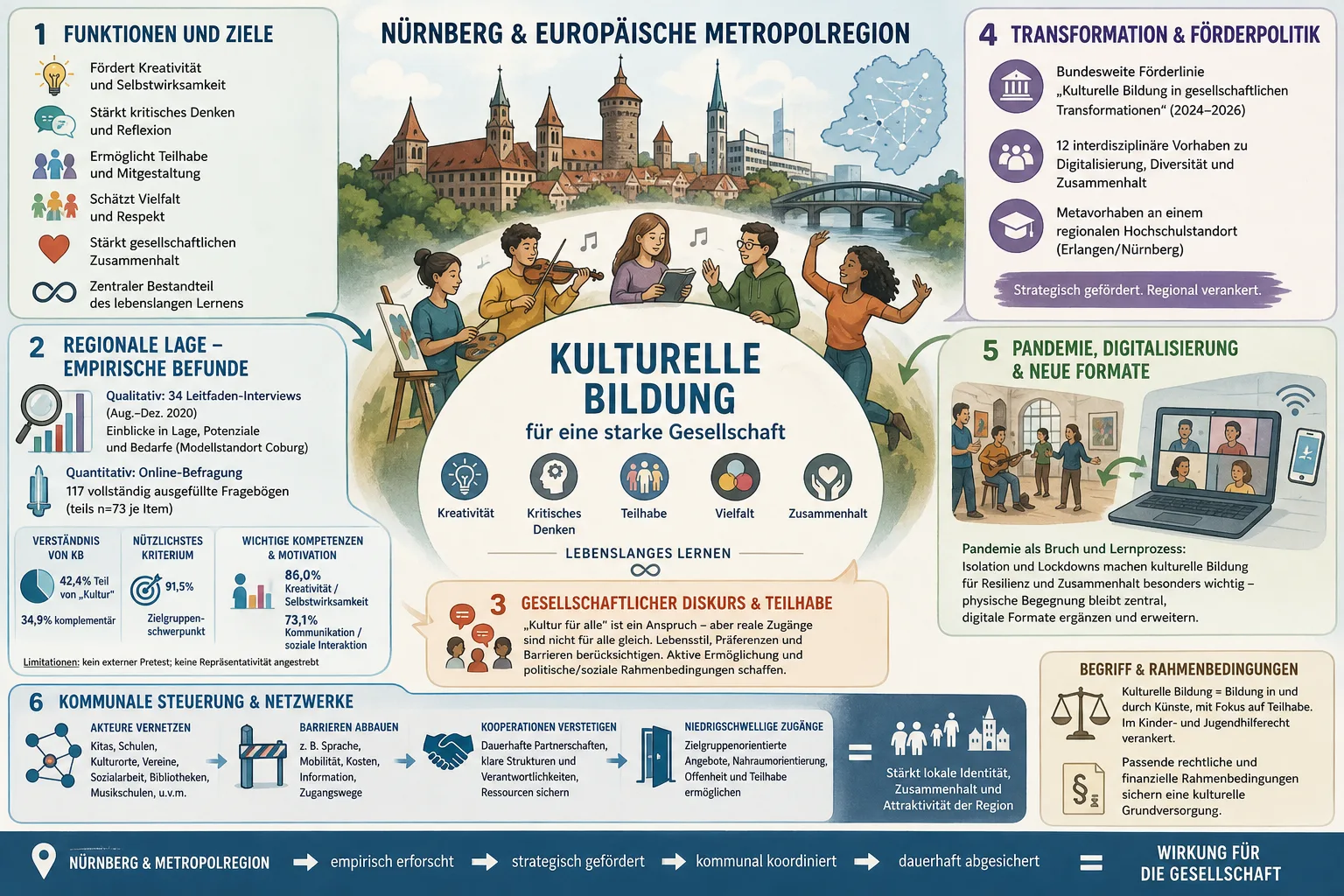
1) What Cultural Education Can Achieve in Nuremberg in the Future
Cultural education means learning in and through art and culture—for example, theater, music, dance, visual arts, literature, media art, and digital cultural forms. In the coming years, its impact will become particularly visible where processes are at the center: creating together, negotiating different perspectives, dealing with conflicts, listening, contradicting, and finding a well-founded position.
For societal discourse, this is exactly what is central. If Nuremberg creates spaces where people with different backgrounds work together creatively and on an equal footing, competencies are likely to emerge that can strengthen democratic participation—in particular:
- Self-efficacy: People experience that their voice and contribution make a difference.
- Dialogue skills: Opinions are exchanged, justified, and negotiated respectfully.
- Critical thinking: Content is reflected upon, sources are questioned, and narratives are examined.
- Social cohesion: Joint projects create a sense of belonging across social boundaries.
- Creative problem-solving: Complex topics become artistically manageable and discussable.
2) “Culture for All”: Which Access Nuremberg Should Secure in the Future
So that cultural education truly acts as an invitation to participation in the future, Nuremberg will have to design access in such a way that it does not depend on chance. In practice, these factors are likely to be particularly decisive in the coming years:
2.1 Barriers That Can Be Systematically Reduced in the Future
- Costs: Fees, material costs, and travel distances will continue to be entry barriers if there are no socially compensatory models.
- Accessibility: Opening hours, travel times, and low-barrier locations will determine who can actually use offers.
- Language & Information: Understandable communication (multilingual, clear, findable) will decide on participation.
- Suitability of Formats: Offers will only be effective if they take the interests, life situations, and cultures of the target groups seriously.
2.2 Measures That Are Likely to Be Particularly Effective in the Future
- Low-threshold: Offers in schools, daycare centers, neighborhood centers, libraries, youth clubs, and public spaces—where people already are.
- Co-creation instead of “top-down programming”: Target groups are involved in conception, selection of topics, and presentation forms.
- Inclusion & Accessibility: Access is planned so that people with disabilities, caregiving responsibilities, or limited mobility can participate.
- Transparency: Clear information about costs, requirements, data protection (for digital formats), and contact persons.
3) Nuremberg & Metropolitan Region: How Regional Networking Can Have an Impact in the Coming Years
In the coming years, cultural education in Nuremberg will likely grow steadily if it is not planned in isolation. Regional networking can reduce duplication, ensure quality, and increase reach—especially at the interfaces between the city and surrounding areas.
3.1 Cooperations That Will Be Sustainable in the Future
- Education & Culture: Schools, daycare centers, after-school care centers, vocational schools, and universities cooperate long-term with cultural institutions and independent actors.
- Youth Services & Culture: Youth centers and social work providers combine cultural projects with a focus on everyday life and prevention.
- Neighborhood and District Work: Culture becomes part of local development goals (encounter, safety, neighborhood, participation).
- Civil Society: Associations, initiatives, communities, and migrant self-organizations are involved as equal partners.
3.2 What Municipal Governance Should Achieve in the Future
So that offers do not depend on short-term project constellations, municipal governance will likely prioritize the following tasks in the coming years:
- Clear responsibilities: Who coordinates, who allocates funds, who oversees quality and evaluation?
- Transparent funding logic: Understandable criteria, fair access, realistic timeframes, and clear expectations for impact and documentation.
- Data-based planning: Needs assessments and monitoring (without over-bureaucratization) to identify supply gaps.
- Quality development: Training, fee recommendations, child protection and safeguarding concepts, accessibility.
4) Funding & Financing: What Will Decide Success in the Coming Years
For sustainable cultural education, in the coming years it will be less the number of individual projects that is decisive, but rather continuity. Many successful formats only emerge through repetition, reliable relationships, and stable teams.
4.1 Funding Principles for More Reliability
- Multi-year funding: Programs that allow for several years of duration are likely to have significantly more impact than short cycles.
- Personnel capacities: Planning, coordination, mediation, and community work take time—and must be considered financially.
- Quality instead of output numbers: Evaluation should not only be about “how many participants,” but also learning processes, access, cooperation, and sustainability.
- Fair pay: Appropriate fees and clear framework conditions will determine whether professionals remain available in the long term.
Additionally, in the coming years, nationwide and state programs, foundations, and EU formats (depending on the call for proposals) can supplement—provided they are sensibly coordinated with municipal goals. It will be crucial that funding logics are not planned past the realities of the target groups.
5) Transformation & Digitalization: Which Formats Nuremberg Can Expand in the Future
In the coming years, cultural education in Nuremberg will likely be conceived more hybrid: in-person remains central for relationships and trust, digital elements can enable reach, accessibility, and new forms of expression.
5.1 Digital Opportunities
- Hybrid workshops: Participation on-site and online can include people with limited mobility or time windows.
- Media literacy: Creative work with audio, video, AI-supported tools, and platforms can strengthen critical thinking and source competence.
- Documentation & visibility: Digital presentation formats can share results and bring discourses into the urban public.
5.2 Digital Responsibility
- Data protection: Participants—especially children and young people—need clear, secure frameworks.
- Accessibility: Subtitles, plain language, device access, and supportive formats are prerequisites for equitable participation.
- Platform criticism: Reflective handling of algorithms and disinformation will gain importance in educational formats.
6) Spaces for Discourse in Nuremberg: How Cultural Education Can Promote Democratic Culture in the Future
If Nuremberg understands cultural education as part of democratic infrastructure, more spaces are likely to emerge in the coming years where societal questions are not only discussed but also artistically experienced and negotiated. This concerns topics that move many people directly—for example, cohesion, diversity, intergenerational justice, climate, and urban development.
This is particularly effective when projects:
- are locally anchored (in the neighborhood, at school, in the association),
- are moderated and protected (clear conversation rules, protection against discrimination),
- become visible (performances, exhibitions, public dialogue formats),
- are connectable (linking to municipal processes, youth participation, neighborhood forums).
7) Outlook: Priorities for the Next Steps in Nuremberg
So that cultural education and societal discourse in Nuremberg can grow robustly in the coming years, these priorities will be particularly guiding for action:
- Anchor cross-section: Culture, education, social affairs, integration, urban development, and health/prevention (where appropriate) consider cultural education as a joint field of action.
- Ensure equitable access: Costs, routes, language, and accessibility are planned from the outset.
- Create multi-year structures: Funding and cooperation are designed so that relationships, trust, and quality can emerge.
- Make quality transparent: Clear standards (protection, fair pay, accessibility, evaluation) create trust among participants and funders.
- Enable discourse: Cultural education is planned as a place for participation and co-creation—not just as a leisure activity.
This way, Nuremberg can be a city in the coming years where cultural education does not take place “in addition,” but acts as a reliable foundation for participation, integration, and democratic dialogue.