Digital Art & NFT Exhibitions in Nuremberg
Digital Art & NFT Exhibitions in Nuremberg: What You Can Expect in the Coming Months
Digital art doesn't have to be confined to walls: In the coming months, formats that bring art to your smartphone, into multimedia guides, 360° tours, and, in the future, token-based models (NFTs) are expected to continue growing in Nuremberg. This page helps you realistically assess upcoming digital art offerings in Nuremberg, find reputable options, and use them sensibly—without hype, but with a clear view of opportunities, limitations, and questions about copyright, sustainability, and access.
What (will) count as digital art in Nuremberg's museums?
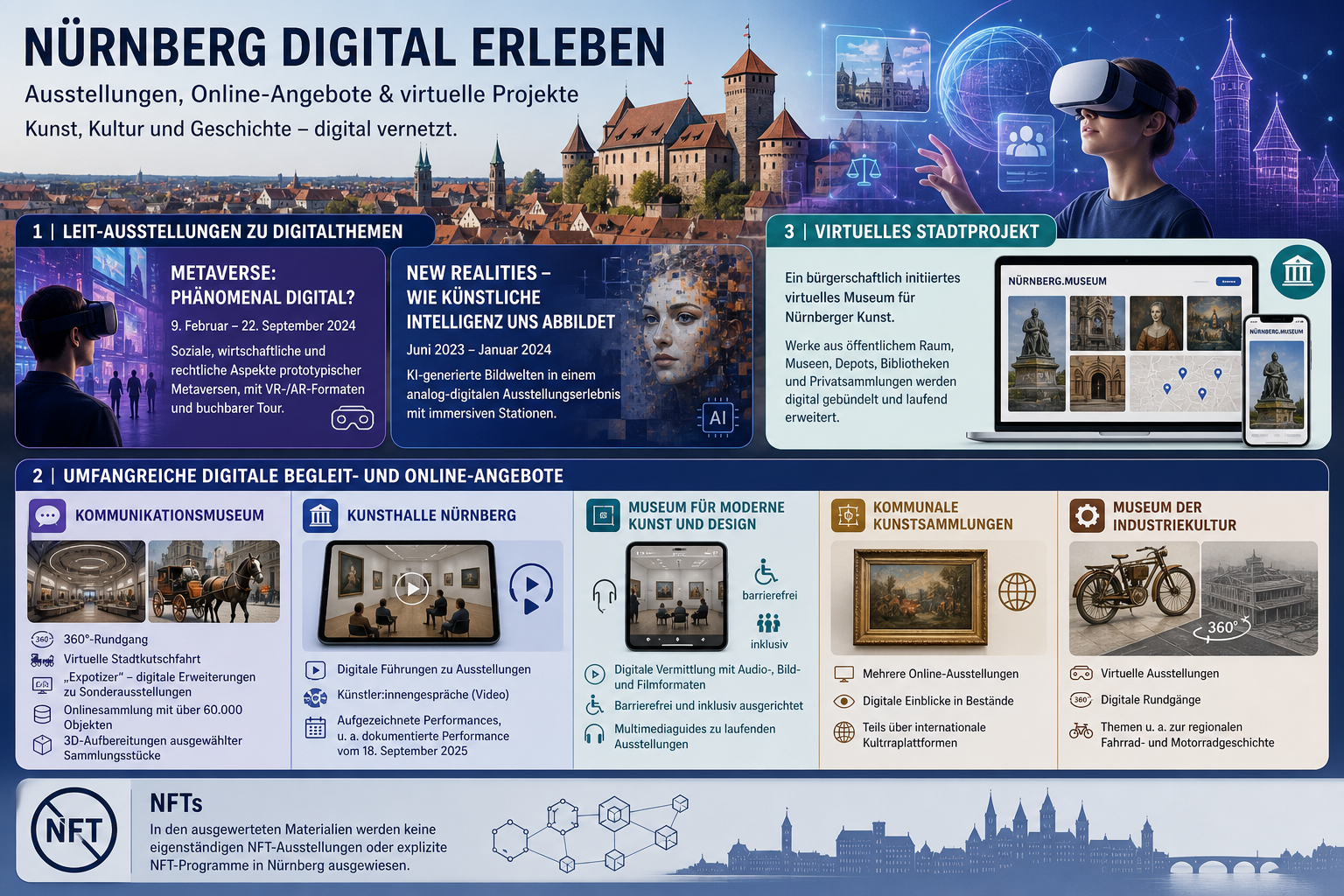
If you are looking for digital art in Nuremberg, it can look very different in upcoming programs. Often, it's not just about "art on a screen," but rather a bundle of artistic media and mediation:
- Media art & interactive installations (e.g., sensor-based works, projections, generative art).
- AI-related art and mediation formats (e.g., workshops, talks, or curated contexts on image generators, datasets, and bias).
- AR/VR experiences (e.g., enhancements in exhibitions, virtual tours, or walkable digital scenes).
- Digital collections (online collections, curated online exhibitions, digitized archives, 3D objects).
- Multimedia guides on-site (audio, video, text, easy language, subtitles, possibly sign language/barrier aids depending on the offer).
The key point: In the coming months, digital art in Nuremberg will likely appear hybrid—as an interplay of exhibition space, online content, and accompanying events. This hybridity is, for many institutions, the most pragmatic way to strengthen reach, accessibility, and context.
Where can you find upcoming digital exhibitions & events in Nuremberg?
Because programs change continuously, the most reliable way to find future digital art and NFT-relevant offerings is always the primary source: the official channels of the respective institutions. For your planning in the coming weeks and months, these steps are especially helpful:
- Check the official event and exhibition pages of Nuremberg's museums, art halls, and cultural venues (dates, durations, ticket info, accessibility details).
- Subscribe to newsletters and social media channels, as digital formats (workshops, streams, artist talks) are often announced at shorter notice.
- Use municipal cultural calendars (especially if you are looking for lectures, panels, performances, or festivals with a media art focus).
- Use program keywords in your search, e.g., "media art," "interactive," "VR," "AR," "digital tour," "online collection," "blockchain," "token," "Web3."
If you are specifically looking for NFT exhibitions: Pay attention in announcements to whether NFTs appear as artworks, as a ticketing/member model, or only as a discussion topic. These are very different things—and they have different legal and ecological implications.
Formats you can expect in the coming months
1) Virtual tours and 360° insights (time- and location-independent)
For upcoming exhibitions, virtual tours and 360° views are expected to become even more important—as a preview, as a supplement after the visit, or as an alternative for people who cannot travel. Good virtual offerings provide not just images, but also context: artwork texts, audio stations, interviews, or curated paths.
2) Digital collections and curated online exhibitions
In the coming months, it will be especially practical for many visitors if museums make their collections more visible online. Such platforms are suitable for:
- Preparing for a visit (themes, artists, eras, object groups).
- Deepening after the visit (finding works again, reading up on sources).
- Teaching and further education (curated sets, digital dossiers).
For you as an audience, a good quality feature is whether an online object comes with basic information: title, date, material/technique, rights information, origin/provenance (as far as published), and a reliable source reference.
3) Multimedia guides and more accessible mediation
Many institutions will continue to digitize their mediation in the future—not as an end in itself, but to create access: subtitles, audio description, variable font sizes, content in easy language, or multilingual versions. If you need accessible offerings, it's worth checking the service info of the respective institution before you go.
4) Talks, workshops, and "critical digital formats"
Especially with AI, Metaverse, and blockchain, it is expected that institutions will increasingly focus on discussion formats: panels, artist talks, tours focusing on technology & society, or workshops on media literacy. For visitors, these formats are often the best way to understand terms (and boundaries) beyond marketing.
NFT exhibitions in Nuremberg: realistic scenarios for the future
NFTs are not an art style, but a technology for assignment and tradable reference (token) on a blockchain. Whether and how Nuremberg institutions will use NFTs in the future can vary greatly—and depends heavily on curatorial goals, rights, sustainability, and audience benefit. For the coming months, these scenarios are especially plausible:
- NFTs as a topic in lectures or mediation formats: What does "digital ownership" mean, what is originality on the net, how are markets changing?
- NFTs as a companion object to digital art: for example, limited digital editions that provide additional context (e.g., making-of, interviews, curatorial texts) without replacing the physical visit.
- NFTs in cooperation with local creatives: If regional artists or collectives are already working in Web3 contexts, future collaborations can build a bridge between the international scene and the local public.
- Experiments with membership or ticketing: individual projects could discuss tokens as proof of membership. For the audience, it is especially important that alternatives without wallet/payment risks are offered.
For your planning: You can recognize a reputable announcement by the fact that it clearly explains what added value an NFT is supposed to provide, how rights (copyright, usage rights) are handled, and what technical requirements arise. Pure buzzword communication without details is a warning sign—especially for paid offerings.
Law, Ethics & Sustainability: what organizers and audiences should pay attention to
Copyright & Usage Rights
Even in future digital exhibitions, the core question remains: What may be shown, stored, shared, or reused? Especially with online exhibitions, 3D objects, AI images, and tokenized works, transparency about rights is crucial. The EU copyright rules and official guidelines provide an important framework for this (see sources).
Transparency with AI content
If AI plays a role in upcoming exhibitions or mediation offerings, a good standard is to clearly state:
- whether content was AI-generated, AI-assisted, or curated/created by humans,
- which data and training assumptions are relevant (as far as disclosed),
- which limitations (bias, hallucinations, data protection) need to be considered.
This helps visitors to correctly assess works and statements—and strengthens trust.
Sustainability with Blockchain/NFT
For NFT projects, the question of energy consumption and climate impact will remain relevant. Reputable future projects will likely explain which blockchain/technology is used, what measures are planned to reduce environmental impact, and whether there are alternatives (e.g., without tokens, or with particularly energy-efficient methods).
Access & Inclusion
Digital offerings can open up access—or create new barriers (devices, accounts, wallets, paywalls). Good programs in the coming months will therefore be planned to be as accessible, data-efficient, and with alternatives as possible, so that art does not depend on technology ownership or platform logic.
Practical tips for your visit (on-site & online)
- Plan ahead: Shortly before your visit, check the official program info (durations, times for tours, notes on VR/AR stations, age/health notices for VR).
- Use your smartphone sensibly: Bring headphones, charge batteries (or bring a power bank), and pay attention to WiFi/offline notes if a multimedia guide is offered.
- Check accessibility info: If you need subtitles, audio description, or easy language, find out in advance which digital offerings are available for this.
- Look closely at NFT offerings: Read terms, rights and return policies, data protection info, and technical requirements. Reputable providers explain clearly what you are buying (and what not).
- Deepen after your visit: Use online collections and recorded talks to view works again and check backgrounds—this significantly increases the value of your visit.
Sources & further information
- ICOM – Standards & Guidelines (Resources) — Basics for museum work and mediation (accessed 2026-05-13)
- UNESCO – Digital Transformation (Culture/Heritage) — Overview of digital transformation in the cultural sector (accessed 2026-05-13)
- EUR-Lex – Directive (EU) 2019/790 (DSM Copyright Directive) — Relevant legal framework for digital uses and online contexts (accessed 2026-05-13)
- AI Act Explorer (Overview of the EU AI Act) — Guidance on AI regulation in the EU and transparency requirements (accessed 2026-05-13)
- Goethe-Institut – Media Art (Thematic Access) — Classification of media art and digital art forms in the cultural context (accessed 2026-05-13)