How Nuremberg Is Changing: New Cultural Venues, Museum & Spaces
How Nuremberg Will Change – New Cultural Venues and Ideas in the Coming Months
In the coming months and years, Nuremberg will not only be perceived as a city of history, but increasingly as a city where contemporary culture is created: in museums, in (re)used buildings, in studios, on squares and in parks. This overview bundles emerging developments and shows how you will likely be able to find, classify, and meaningfully support future cultural formats.
Interim Uses: How Vacant Spaces Become Cultural Offerings
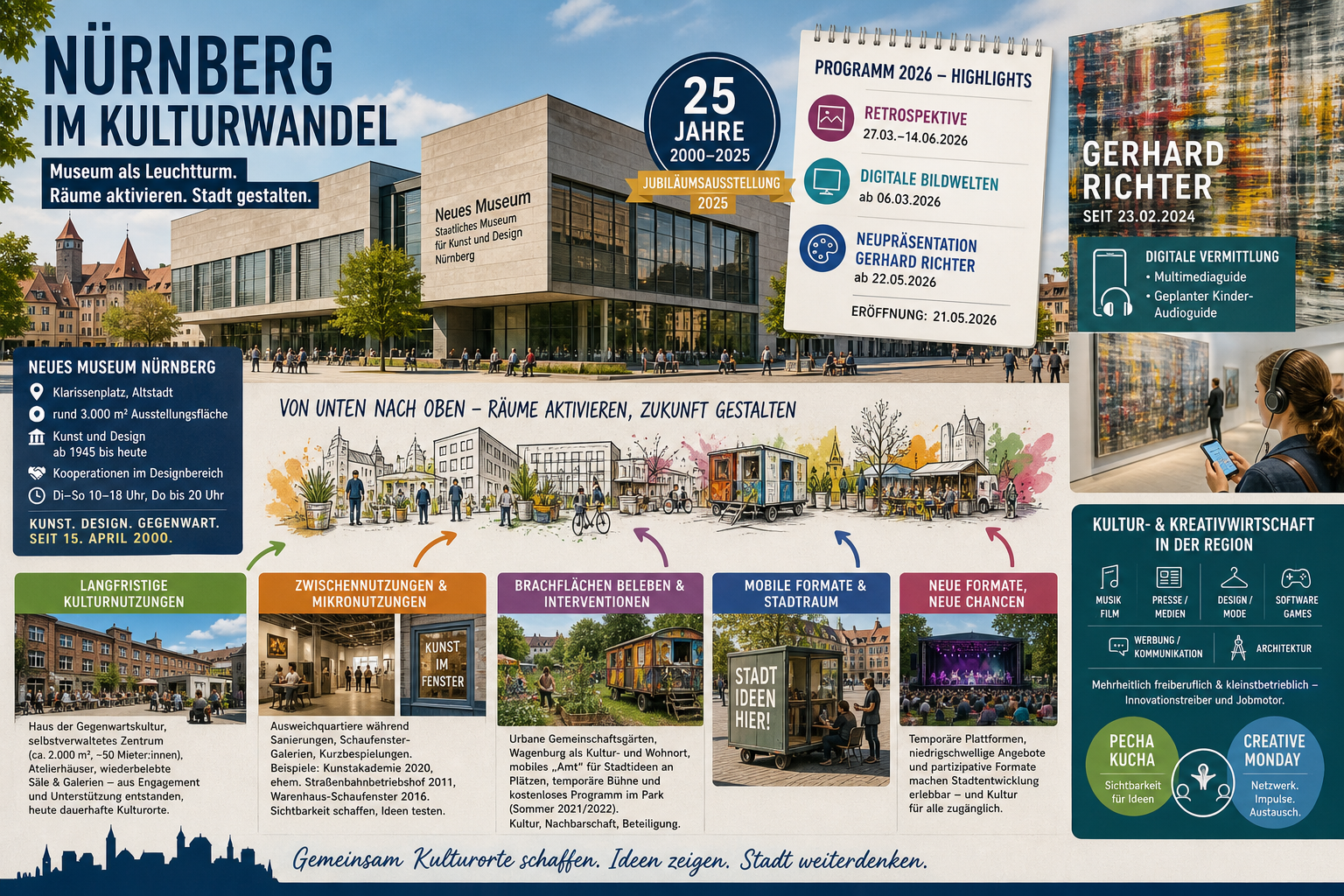
In the coming years, more interim uses are likely to become visible in Nuremberg: temporarily usable shops, courtyards, side rooms, former commercial spaces or office units that are not immediately rented out long-term. These “in-between spaces” in particular can become test fields for culture, as they allow for experimentation without the need to immediately finance a permanent structure.
What Can Emerge in Practice
- Showcase Formats: temporary mini-exhibitions that work without admission and reach passersby spontaneously.
- Pop-up Project Spaces: short-term installations, performances, readings, or design presentations.
- Interim Quarters: alternative spaces for clubs or initiatives when main locations are being renovated, refurbished, or reorganized.
For interim uses to work well in the future, three factors are particularly crucial: clear agreements (duration, liability, key authority), realistic safety and fire protection requirements, and transparent communication in the neighborhood. If this succeeds, interim uses will not just be “gap fillers,” but a tool to build new audiences and prepare for later permanent solutions.
Permanent Creative Spaces: Studio Houses, Production Sites, Open Workshops
In addition to temporary spaces, permanent creative venues are also likely to develop further: studio collectives, production and rehearsal rooms, shared workshops, and houses where work, mediation, and public engagement come together. Such places are particularly effective because they create continuity: art is not only shown, but produced, discussed, mediated, and anchored in networks over a longer period.
Features These Places Will Often Share in Nuremberg
- Mixed Uses: studios, project spaces, seminar rooms, workshops, and small event areas under one roof.
- Regular Opening: open studio days, tours, neighborhood evenings, workshop courses.
- Cooperations: collaboration with schools, universities, social organizations, or local businesses.
- Low-Threshold Formats: short introductions, participatory offers, clear language, more accessible entryways where possible.
For the cultural and creative industries, such spaces are likely to become even more important: those working freelance or in small teams need affordable, flexible infrastructure. At the same time, spatial proximity often leads to more cooperation – for example, between design, art, music, software, film, or architecture.
City as Stage: Formats in Public Space
A tangible part of the cultural transformation will increasingly take place outdoors: on squares, in parks, on interim lots, and in neighborhoods where people are already on the move. Such formats are likely to increase further because they lower entry barriers and make culture part of everyday life.
Formats That Will Be Particularly Plausible in Nuremberg
- Temporary Stages and Platforms for music, talks, and small performances.
- Mobile Information and Participation Stands that connect culture, urban development, and participation.
- Community-Oriented Garden and Neighborhood Formats that integrate workshops, readings, or small exhibitions.
It will be crucial that such offerings are reliably communicated (location, time, weather alternatives, accessibility information) and that residents are involved early on. Then, public space can become not just an event area, but a place where different milieus come into conversation with each other.
What This Will Mean for Residents, Economy, and Visitors
For Residents
Residents will likely have more opportunities to experience culture spontaneously: on the way home, while shopping, or in the park. Through short, open formats (window exhibitions, open studios, neighborhood events), access will tend to become easier, as less planning and prior knowledge are required.
For the Local Economy
Vibrant cultural venues will often make neighborhoods more attractive – for professionals, founders, gastronomy, and retail. At the same time, creative venues are often experimental environments: where new formats are tried out, contacts, services, prototypes, and sometimes new business models emerge. To ensure that the effects remain positive in the long term, it will be important to consider cultural development and social compatibility together.
For Visitors
Visitors will get to know Nuremberg in the future not only through classic sights, but through a network of institutions and smaller, changing venues. The combination is particularly appealing: a museum visit as orientation, supplemented by project and off-spaces as well as formats in public space. This way, a stay can become more diverse without relying solely on major program points.
How You Will Be Able to Experience (and Help Shape) the Cultural Transformation
- Bundle programs purposefully: Use the official cultural calendars and channels of the city and venues to see upcoming dates early and check for short-term changes (weather, location, admission).
- Plan routes anew: Deliberately take paths that lead past potential interim uses (vacant shop spaces, courtyards, ground floor zones). Many future formats will take place “on the edge of the obvious.”
- Prefer open formats: Open studio days, workshop evenings, talks, and short tours lower the entry barrier and help you see people and places again – occasional visits can become routine.
- Assess participation realistically: If you want to get involved, start with low-threshold options (volunteer services, membership, donations, material support). Binding roles are best developed step by step.
- Respectful interaction with neighborhoods: New cultural venues work best in the long term when noise, waste, routing, and safety are transparently regulated and residents have contact persons.
Overall, Nuremberg is likely to become more tangible in the coming years as a city where institutions and initiatives operate in parallel: museums provide orientation, while interim uses, studio houses, and public formats open up new perspectives on urban space, everyday life, and coexistence.