Zero Waste & Green Events in Nuremberg – Living Sustainability
Zero Waste & Green Events: How Nuremberg Can Celebrate Sustainably in the Future
How can a large city festival in Nuremberg be organized in the future so that as little waste as possible is generated? And why will the arrival and departure of guests often have the greatest impact on the CO₂ footprint at upcoming events?
This article explains which measures are likely to be at the forefront of future Green Events in Nuremberg: Reusable deposit systems, consistent waste prevention, smart mobility, energy-efficient technology, and regional, fair catering. You will also receive practical checklists on how, as a visitor, you can make future events significantly more sustainable with just a few decisions.
Green Events in Nuremberg: From Guiding Principles to Implementation at Upcoming Events
At future events on public spaces in Nuremberg, sustainability will likely play an even greater role in planning than before. The focus will be on ecological, social, and organizational criteria: less waste, fewer emissions, transparent communication, and better accessibility for different target groups.
For organizers, this will mean: Sustainability is not decided on the day of the event, but already in the concept phase. Instead of single-use as the "standard solution," reusable, reusable materials and digital information channels will be planned in the future.
At larger events, a structured disposal and waste concept will also play a central role: Where are collection points located? Which fractions are separated? How is the system made easily understandable for guests? The goal will be not only to dispose of waste correctly, but to avoid it in advance.
Reusable, Waste Prevention & Recycling: How Nuremberg Festivals Will Become Cleaner in the Future
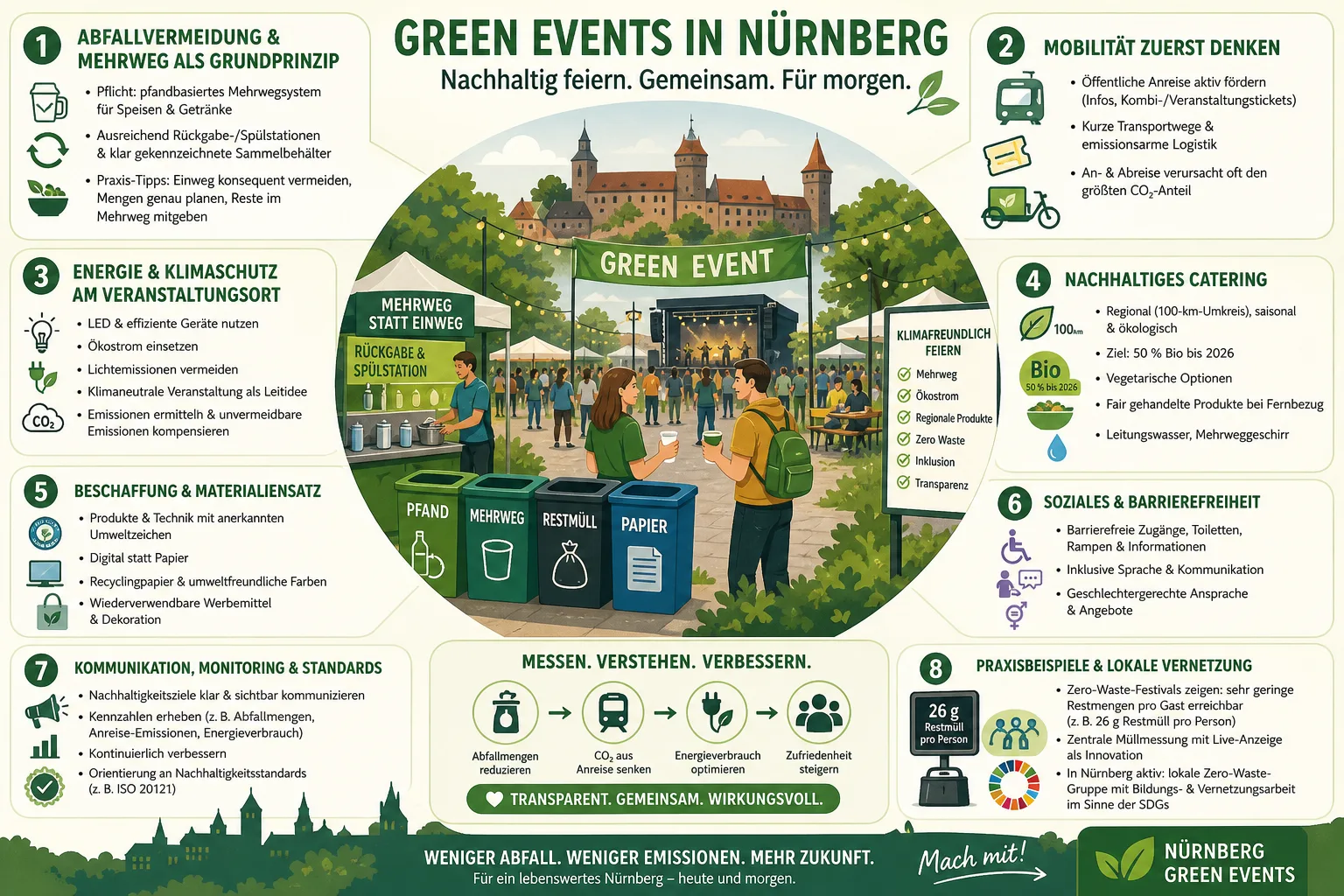
At upcoming festivals and events in Nuremberg, deposit-based reusable systems will likely form the basis for food and drinks, especially if the event takes place on city property or follows corresponding guidelines. The key is not just the cup, but the entire system behind it.
What organizers should plan for in the future
- Sufficient return points: Several, clearly visible return points will avoid bottlenecks and increase the return rate.
- Clear deposit communication: Uniform signs at distribution and return points will reduce misunderstandings.
- Well-designed waste islands: Few, large collection points with clear signage will improve separation quality.
- Reduced material variety: The fewer different types of packaging in circulation, the better recycling will work in practice.
How you as a guest can make the biggest impact in the future
- Consistently return reusables: If you return cups, plates, and cutlery completely, you stabilize the system and reduce losses.
- Separate correctly: Only throw waste where the fraction is clear; if unsure, asking at the info point is often the best solution.
- Fewer "spontaneous purchases" with packaging: Those who less frequently request single-use packaging (e.g., extra bags) reduce waste directly at the source.
Recycling will remain important at future Green Events, but as a "second stage" after prevention: First, less waste should be generated, and only then should remaining material be separated and recycled as high-quality as possible.
Mobility, Energy Consumption & Climate Protection: Why Arrival Will Be Crucial at Future Events
At upcoming events, the greatest climate lever will often lie outside the stage area: in the mobility of visitors. Depending on the event format, catchment area, and time of day, arrival and departure can account for a large part of total emissions.
Measures that will be particularly effective in the future
- Communicate public transport first: In event communication, routes by subway, tram, bus, and S-Bahn will be prioritized in the future (before car info).
- Bicycle-friendly infrastructure: Additional bicycle parking spaces and clear bike route signs will encourage more people to switch.
- Ticket & routing integration: Organizers will increasingly check how travel information, timetables, or combo offers can be better integrated into ticketing and websites.
- Bundled logistics: Delivery and dismantling will be more efficient if service provider trips are bundled and routes optimized.
At the event location itself, future Green Events will also focus on energy efficiency: LED technology, demand-based lighting, modern sound and stage technology, and—where possible—electricity from renewable sources.
Important for credibility: If an event makes climate protection claims in the future (e.g., "climate neutral"), transparent criteria will be expected: first avoid and reduce, then account for remaining emissions according to recognized standards, and only compensate for the rest.
Regional, Organic & Fair: What Sustainable Catering Will Look Like at Future Events in Nuremberg
In the future, catering will also remain a central lever: It shapes the experience but at the same time causes emissions and waste along the supply chain. At future Green Events, the following principles are likely to dominate:
- Seasonal and regional: A food selection oriented to the season and strengthening regional supply chains.
- More plant-based options: A larger vegetarian and vegan offering will generally reduce the environmental impact per portion.
- Increase organic share: Where available, organic foods will be preferred to reduce environmental impacts in production.
- Fair purchasing for imported products: For coffee, cocoa, or other imported goods, recognized Fairtrade standards will play a greater role in the future.
For beverages, future events will likely focus more on simple, low-waste solutions: reusable containers, refill options, and well-communicated opportunities to use your own water bottles (provided the respective security concept allows it).
Procurement, Communication & Social Sustainability: How Events Will Become More Responsible in the Future
Sustainability at future events will not only be considered ecologically. Procurement, transparency, and participation are just as important.
Procurement & Material Use
- Reuse instead of new purchases: Rental and lending systems (e.g., for furniture, technology, equipment) will reduce material consumption.
- Consider environmental labels: For unavoidable new purchases, recognized labels will provide guidance.
- Digital communication: Programs, site maps, and information will be provided more often digitally in the future to reduce printed materials.
Accessibility & Inclusion
At future Green Events, social sustainability will be particularly measurable by whether as many people as possible can participate. Therefore, more firmly established standards are to be expected for:
- barrier-free routing and accessible sanitary facilities,
- clear, easy-to-read signage and understandable language,
- information on accessibility in advance (website/ticketing), so visitors can plan.
Measurability & Learning from Event to Event
So that sustainability does not remain just a resolution in the future, organizers will increasingly work with key figures: proportion of reusables, waste quantities per fraction, energy consumption, arrival distribution (public transport/bike/car), or delivery logistics. Such data will help improve measures and make statements comprehensible.
How You Can Become Part of Zero Waste at Future Events in Nuremberg
Your influence at upcoming events will be greater than it often feels: Many sustainability systems only work if as many guests as possible participate. These decisions are likely to make the biggest difference:
- Change your arrival: If possible, use public transport or a bicycle for future events; for groups, carpooling can be the exception, not the rule.
- Use reusables correctly: Get your deposit back, follow return routes, don't "take away" cups and dishes.
- Request less waste: Don't ask for extra bags, unnecessary single-use items, or printed materials.
- Try plant-based options: Those who choose vegetarian/vegan more often usually reduce the environmental impact of catering.
If these decisions come together among many people, future events in Nuremberg will not only appear cleaner, but will actually use fewer resources and cause fewer emissions.