
Hugo Harrer
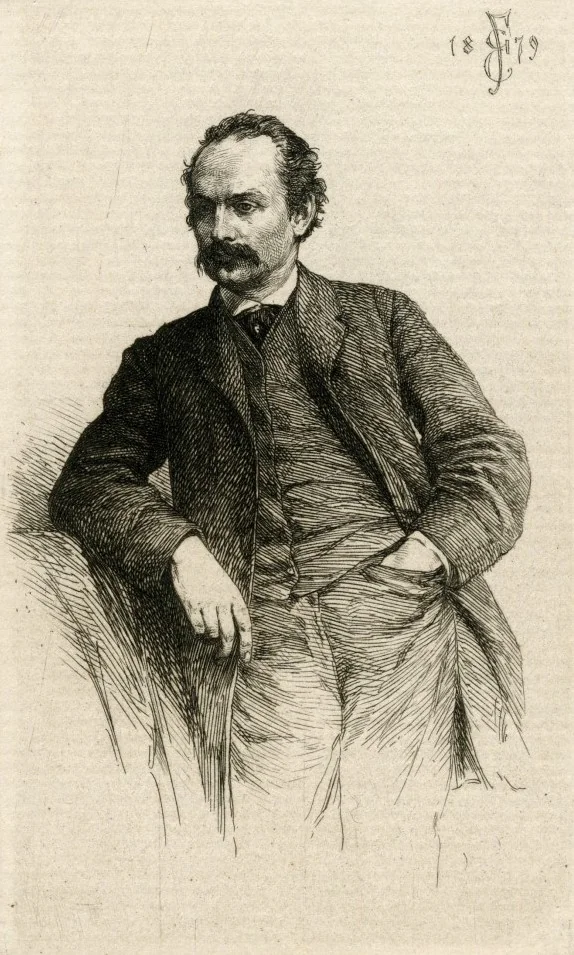
Image from Wikipedia
Image from Wikipedia
Hugo Harrer – the Quiet Realist of the Düsseldorf School between Architecture, Natural Observation, and the Romantic Cityscape
An Artist between Architectural Art and Pictorial Poetry
Hugo Paul Harrer is among those German painters of the 19th century whose work unfolds not in grand manifestos but through precise observation and craftsmanship. Born on February 6, 1836, in Eberswalde and died on December 10, 1876, in Rome, he progressed from an aspiring architect to an independent landscape and architectural painter of the Düsseldorf School. His career exemplifies a generation that combined the study of nature, urban views, and historical architectural forms into a distinctive realism. (de.wikipedia.org)
Harrer was not an academic in the strict sense, but a self-taught artist with a keen eye for space, light, and constructive order. His paintings originated from careful studies on site, sketches, and an attentiveness to the pictorial detail that for him was never mere decoration. This blend of architectural awareness and realistic landscape interpretation makes his position within the Düsseldorf School intriguing to this day. (de.wikipedia.org)
Biographical Beginnings: From Architecture to Painting
Harrer began an architectural education but soon turned to painting and continued his training as a self-taught artist. He received significant impulses through private studies in the ateliers of friends as well as through his own observations of nature. His first paintings were created in Nuremberg, whose architectural backdrop inspired him to early attempts at architectural painting. (de.wikipedia.org)
The time in Nuremberg and later in Munich sharpened his gaze for urban structures and the effects of realistic image composition. In Munich, he was fascinated by the then-modern, groundbreaking realistic painting style of Carl Theodor von Piloty. This influence gave Harrer's development a clear direction: away from mere architectural drawing, towards atmospherically dense paintings with narrative presence. (de.wikipedia.org)
Rome as an Artistic Turning Point and Laboratory for Natural Studies
In 1861 or October 1862, Harrer went to Rome due to a chest ailment. There, he joined Ludwig Passini and worked on studies from nature that garnered attention for their great truth and fidelity. Rome became not just a place of residence for him but an artistic laboratory where he increasingly transferred architecture, ruins, and urban space into pictorial compositions with growing confidence. (de.wikipedia.org)
The years in Rome condensed his profile as a modern realist. He placed emphasis on the exact representation of the reality observed and preferred picturesque angles in decaying ruins as his motifs. This preference reflects a typical trait of the 19th century: history does not appear as a pathetic allegory, but as concrete, visible material in the light of the moment. (deutsche-biographie.de)
Düsseldorf, Malkasten, and the Connection to Landscape Painting
In the years 1867/1868, Harrer stayed in Düsseldorf and studied at the local art academy in the landscape class of Oswald Achenbach. From 1868 to 1872, he was a member of the Düsseldorf artist association Malkasten. These stations firmly anchored him in the milieu of a school known for its international influence, its precision in landscape painting, and its openness to realistic tendencies. (de.wikipedia.org)
After his return to Rome, Harrer continued to work with great discipline, collecting studies on excursions and sending several larger paintings to German art exhibitions each year. His works often depict street scenes, ruins, and Italian coastal landscapes. In this, he navigated a tension between topographical accuracy, atmospheric narrative, and a composition that understands architecture not merely as a background but as a fundamental element of the pictorial effect. (de.wikipedia.org)
Body of Work: Architecture, Coastline, Ruins, and Urban Motifs
Among his preserved works are Old Hanse from 1868, View of the Amalfi Coast at Sunset from 1871, as well as the late Roman motifs At the Theater of Marcellus in Rome and Theater of Marcellus in Rome from 1876. Additionally, there is A Jewish Street Vendor in a Street in Siena. This selection illustrates the breadth of Harrer’s perspective: from the north of the German cultural area to the urban and architectural symbols of Italy. (de.wikipedia.org)
It is particularly in such motifs that Harrer’s signature becomes evident. He was interested in spaces with historical layering, facades, vistas, and the poetic tension between decay and order. His painting combines a documentary impulse with a fine sensitivity to image dramaturgy, allowing even unspectacular street scenes to acquire a quiet intensity. (deutsche-biographie.de)
Style and Classification: Modern Realism with a Sense of Atmosphere
The German Biography explicitly describes Harrer as a "thoroughly modern realist," who endeavored to represent objects exactly as he saw them. This characterization strikes at the core of his artistic self-understanding: observation before idealization, precision before theatricality, structure before mere atmosphere. His works demonstrate that realism in the 19th century could be not cold, but highly sensitive. (deutsche-biographie.de)
His approach to architecture as a pictorial motif is particularly striking. Houses, theaters, ruins, and street spaces function for Harrer not only as subjects but as compositional principles. This makes him intriguing for art historical readers, as his oeuvre illustrates the transition from romantic city and ruin painting to a more sober, accurately observed view of reality. (de.wikipedia.org)
Art Historical Significance and Legacy
Harrer’s significance lies less in broad public fame than in the quality of concentrated, well-observed painting. He was an artist who developed his motifs with perseverance and brought them into the context of German art exhibitions. His work thus represents a solid, internationally oriented image culture of the 19th century, where Düsseldorf and Rome served as artistic poles. (de.wikipedia.org)
Historically on the art market and documentarily, he remains present: Wikipedia references the data sheet of the Rijksbureau voor Kunsthistorische Documentatie as well as auction results on artnet. These traces show that his name has remained visible in the art historical network, even if his oeuvre appears comparatively slim. For collectors, researchers, and lovers of the Düsseldorf School, Harrer is therefore a worthwhile discovery. (de.wikipedia.org)
Conclusion: A Quiet Master of Observation
Hugo Harrer captivates as a painter with a clear, unpretentious pictorial language. His biography unites architecture, natural studies, travel, Roman impressions, and Düsseldorf School tradition into a coherent artist profile. Those interested in landscape painting, urban views, and the fine realism of the 19th century will find in Harrer an artist of remarkable consistency and stylistic discipline. (de.wikipedia.org)
Especially because his works refine the eye rather than overwhelm it, Harrer remains fascinating: as a chronicler of architectural spaces, as a sensitive observer of Italian light, and as a representative of a realism that acts with quietude. His paintings invite viewers to look closer and rediscover the poetic power of the seen. Anyone who can experience his works in person should not miss this encounter. (de.wikipedia.org)
Official Channels of Hugo Harrer:
- Instagram: No official profile found
- Facebook: No official profile found
- YouTube: No official profile found
- Spotify: No official profile found
- TikTok: No official profile found
Sources:
- Wikipedia – Hugo Harrer
- German Biography – Harrer, Hugo
- Wikipedia – Harrer (Name Page)
- Wikipedia – Image and Text Source
- Wikipedia: Image and Text Source